
Most homeowners skim the warranty page of a solar quote and move straight to the price. That’s understandable — but the warranty terms are what actually protect your investment for the next 25 years, and “warranty included” on a quote can mean very different things depending on what’s actually written down. Here’s what each warranty type really covers, what’s commonly excluded, and what to check before you sign.
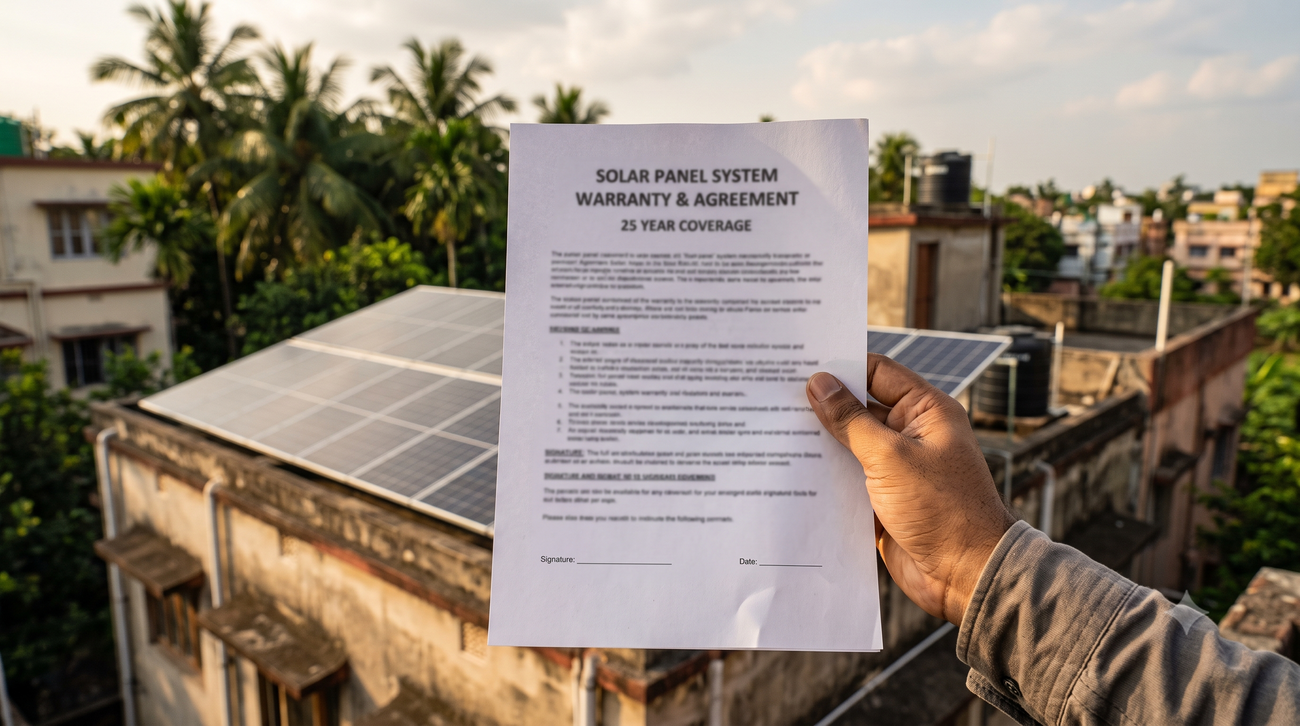
Your System Actually Carries Four Separate Warranties
A single rooftop solar installation isn’t covered by one warranty — it’s a stack of four, each from a different party:
| Warranty Type | Who Provides It | Typical Duration | Covers |
|---|---|---|---|
| Product (material) | Panel manufacturer | 10–15 years | Manufacturing defects, delamination, junction box failure, cracked glass not caused by impact |
| Performance | Panel manufacturer | 25 years | Minimum guaranteed power output as panels gradually degrade |
| Inverter | Inverter manufacturer | 5–10 years | Electronic failure within the covered period |
| Workmanship | Your installer | 1–10 years | Installation quality — mounting, wiring, roof penetrations |
Notice that three of these four come from equipment manufacturers, not your installer. Only the workmanship warranty is actually the installer’s own promise — which matters more than most people realize, as you’ll see below.
What the Performance Warranty Actually Guarantees
Panels degrade slowly every year — typically around 0.5% annually. A performance warranty guarantees your panels won’t fall below a set output curve faster than that. A standard Tier-1 panel today usually guarantees roughly 97% output in year 1, declining gradually to around 84–92% at year 25. If your system’s actual output falls below that guaranteed curve — provable through monitoring data — you have a valid claim for replacement or compensation.
What’s Commonly Excluded — Read This Before You Sign
Warranties protect against defects, not against damage, misuse, or normal wear. Common exclusions across most manufacturers and installers:
- Physical damage from falling objects, mishandling, or someone walking directly on panels
- Improper installation carried out by anyone other than an authorised installer
- Unauthorised modifications to the system after installation
- Non-approved cleaning methods — harsh chemicals or abrasive tools instead of the recommended soft brush and water
- Soiling and shading — dust buildup or shade from a tree is not treated as a “defect,” even though it reduces output
- Acts of god — severe storm or structural damage typically needs separate property insurance, not warranty coverage
The Warranty Most People Overlook — And the One That Actually Fails First

Here’s the part that catches people off guard: if your installer shuts down or simply becomes unreachable, your panel, performance, and inverter warranties survive — they’re contracts with the manufacturers, not with your installer, so that coverage still stands. But your workmanship warranty dies with the company. Roof leaks, wiring faults, and mounting issues become entirely your cost to fix, with no one to call.
This is exactly why we stressed verifying a real, visitable local office in our buyer’s checklist for choosing a solar company in Kolkata and Howrah — a workmanship warranty is only as good as the company standing behind it five or ten years from now.
How to Actually File a Claim
- Identify which warranty applies. A physical defect in the panel itself is a product warranty issue. Output that’s dropped below the guaranteed curve is a performance warranty issue. An inverter that’s stopped working is a separate claim entirely. A roof leak or loose mounting is workmanship — your installer’s responsibility, not the manufacturer’s.
- Document everything. Photos of physical damage, and generation data from your monitoring app or inverter showing the underperformance with dates. Claims without evidence are far harder to process.
- Keep your paperwork from day one. Serial numbers, invoices, and the original warranty certificates — issued at installation, not something you have to chase down later.
- Contact the right party first. Manufacturer defects go to the manufacturer (often through your installer as the registered dealer); workmanship issues go directly to your installer.
What to Ask For Before You Sign
When comparing quotes, don’t just ask “is there a warranty” — ask for these specifics in writing:
- Exact product and performance warranty years, and the guaranteed output percentage at year 25
- Inverter warranty length, and whether it’s extendable
- The installer’s own workmanship warranty period — this is the one that varies most between companies
- Whether warranty documentation is handed over at project completion, not “available on request” later
If a quote you’ve received doesn’t spell these out clearly, it’s worth revisiting our cost breakdown guide — a noticeably cheaper quote sometimes reflects weaker warranty terms rather than better value.
Our Warranty Standard at Apris Solar
As an EPC (Engineering, Procurement, and Construction) company, Apris Solar only installs Tier-1, ALMM-listed panels with full manufacturer product and performance warranties, and we back every installation with our own workmanship warranty — documented in writing at project completion, not verbally promised. Since we handle design, procurement, and installation ourselves rather than subcontracting the work out, there’s one accountable team behind your warranty, not a chain of vendors.
Want to see how your numbers work out first? Try our solar calculator for a personalized cost and savings estimate.
📞 WhatsApp us or visit apris.in/solar-company-contact-us to get full warranty terms in writing before you decide.