
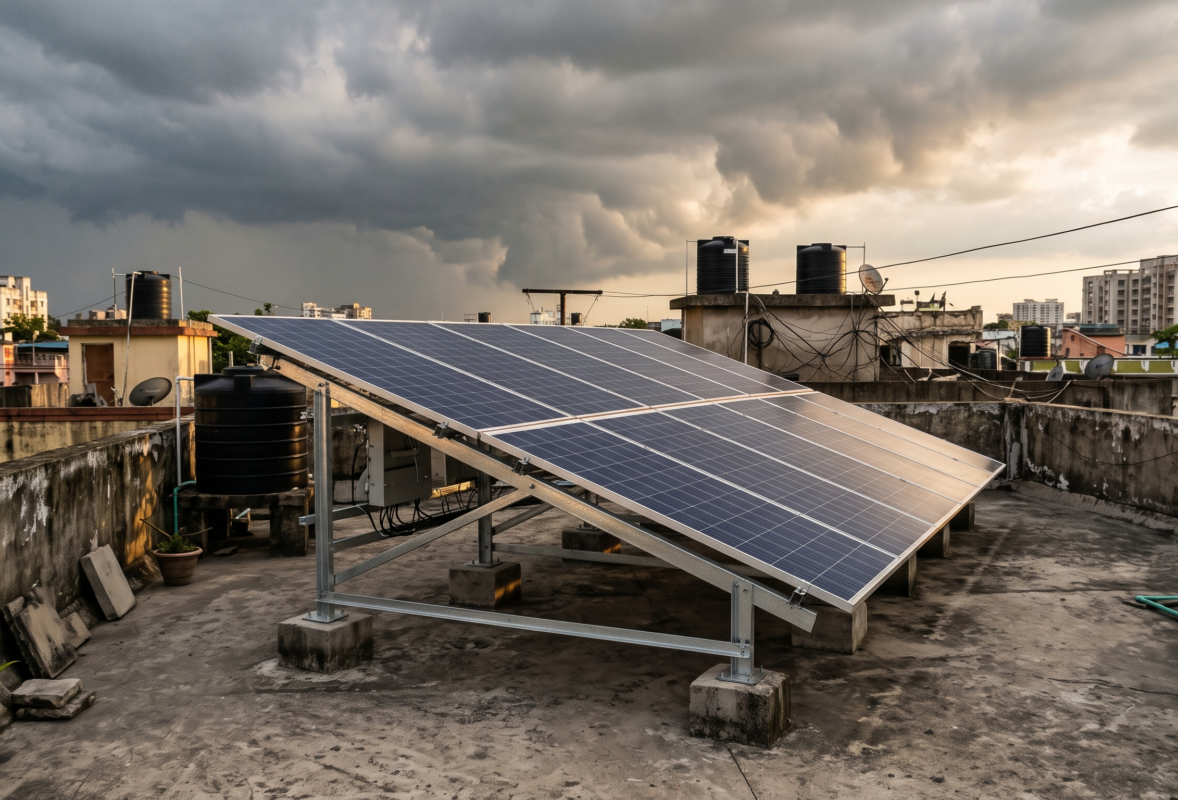
Anyone who has lived through a Kalbaishakhi squall, Amphan, or Remal knows what wind does here: hoardings down, trees uprooted, tin sheets in the street. So “will my solar panels stay put?” is a fair question, and most solar guides never answer it. The short answer is that a properly designed and anchored system is built for exactly this. A poorly designed one is the real risk. In most cases the panels themselves are not the weak point. The mounting structure, and how it is fixed to your roof, is.
What Storms Actually Look Like Here
- Cyclone Amphan (May 2020): the India Meteorological Department recorded gusts of about 130 km/h at Dum Dum and 112 km/h at Alipore, according to IMD’s report on the storm.
- Cyclone Remal (May 2024): IMD forecast landfall winds of 110 to 120 km/h, gusting to 135 km/h, with an orange alert for Kolkata and Howrah.
- Kalbaishakhi: these pre-monsoon squalls are shorter and less predictable, but they arrive suddenly and hit rooftops hard.
What the Wind Code Says
India’s wind-load code, IS 875 Part 3, gives every location a basic wind speed. Kolkata is commonly listed at 50 m/s, which is about 180 km/h as a 3-second gust at 10 m height over open ground, for a 50-year return period. That puts Kolkata, and neighbouring Howrah, among the higher wind zones on the national map.
That number is a starting point, not the figure your roof is designed for. A structural engineer adjusts it for the height of your building, the surrounding terrain, and where on the roof the panels sit. Roof edges and corners see much higher wind suction than the middle of the roof.
You will also often see a standard of 150 km/h in rooftop solar specifications, including several state agencies’ technical requirements. It is a useful minimum benchmark, but Kolkata’s code speed is higher, which is why it is worth asking to see the calculation for your roof rather than accepting a generic number on a brochure.
Where Rooftop Solar Actually Fails in Storms
When systems come loose, the causes are usually avoidable:
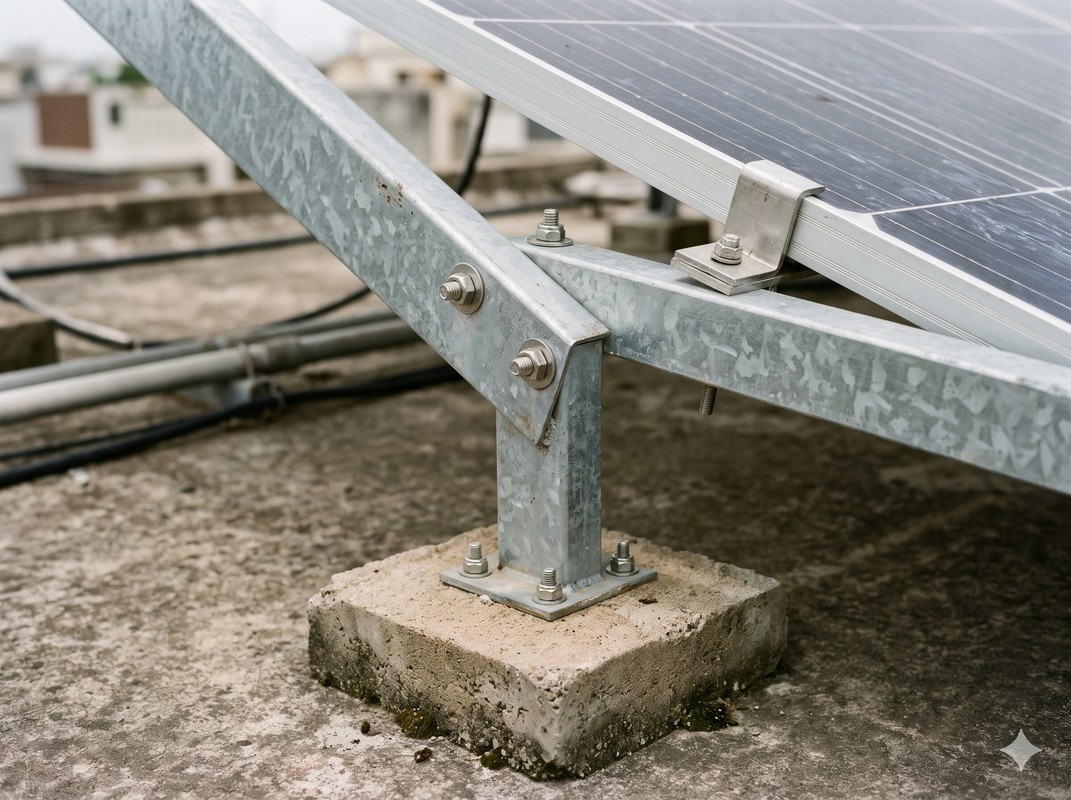
- Light or under-designed structures with thin steel, few fixing points, or poor bracing
- Panels placed too close to roof edges and corners, where wind suction is strongest
- A weak roof underneath, such as old tin sheets, corroded fasteners, or a cracked parapet
- Corrosion over time. Bengal’s humidity is hard on cheap steel, which is why galvanising quality matters over a 25-year life
- Loose cabling and clamps that flap in the wind and wear through
What to Ask Before You Sign
- “What wind speed did you design the structure for, and who calculated it for my roof?” Ask to see the calculation, not just a claim.
- “What steel and coating do you use?” Standard specifications call for hot-dip galvanised steel with a coating of at least 80 microns under IS 4759, plus stainless steel (SS 304) fasteners. Aluminium structures also work if the manufacturer rates them for the wind speed.
- “How will you anchor it to my type of roof?” On a flat RCC roof, this usually means concrete foundations or ballast blocks that the design sizes for your wind load. On tin or sheet roofs, the installer must fix the system so it carries the load properly and the roof stays watertight.
- “How far from the roof edges will the panels sit?” Edge and corner setbacks are part of a good design.
- “How will you secure the cabling and earthing?” Installers should clamp cables along the roof and walls and earth the structure properly.
- “Does a written warranty cover the structure?” Our solar warranty guide explains why workmanship cover, which includes mounting, is the one that depends on your installer.
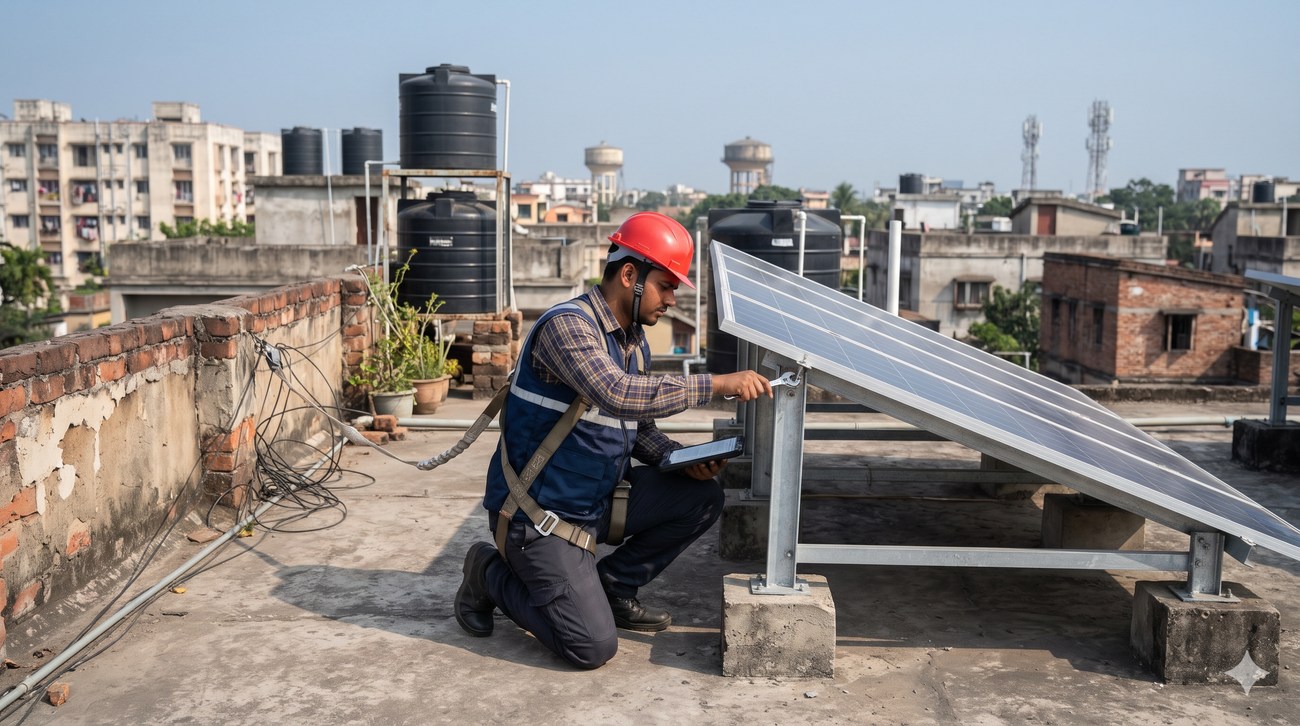
MNRE’s guidance on grid-connected rooftop plants sets out many of these structural expectations, and a good installer should be comfortable working to them.
Before and After a Storm
- Before a severe cyclone warning, ask your installer whether they advise switching off the system at its isolators, and keep loose objects off the roof, because they become projectiles.
- After a storm, do not climb onto the roof straight away. Check from the ground first for shifted panels, loose cables, or an inverter fault, and photograph anything unusual.
- Call your installer for an inspection if anything has moved. It is worth catching a loosened fixing early.
One more point: warranties normally treat storm damage as outside their scope, so panels and structure need to be covered by your property insurance. Our post on solar panel myths also covers why panels themselves handle heavy rain and hail well.
Storm-Ready Solar with Apris Solar
As an EPC (Engineering, Procurement, and Construction) company installing in Kolkata and Howrah, Apris Solar specifies the mounting structure in your quote and designs it for the roof it is going on. At your free site survey we check your roof type, condition, and layout, and we are happy to walk you through the structure details in writing before installation. Every installation comes with five years of free after-sales service.
If you are comparing installers, our buyer’s checklist lists the other questions worth asking. For a quick size and cost estimate, try our solar calculator.
📞 WhatsApp us or visit apris.in/solar-company-contact-us to book a free site survey.