
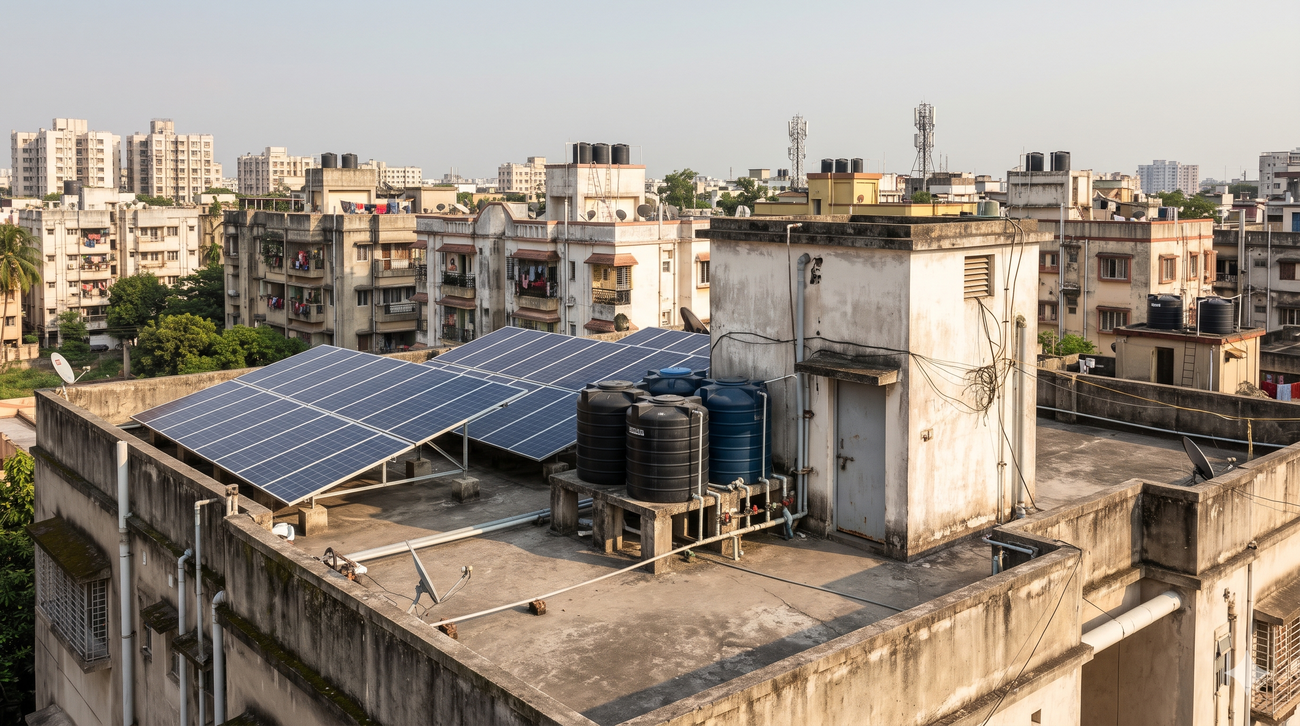
Much of Kolkata lives in apartment buildings, and every society pays for the same shared loads: lifts, water pumps, and corridor and lobby lights. Those bills land in everyone’s maintenance charges every month. PM Surya Ghar includes a separate route for housing societies and RWAs, which can claim ₹18,000 per kW for solar that powers common facilities. Here is how the route works, what limits apply, and how to start.
How the Society Subsidy Works
- Rate: ₹18,000 per kW of solar capacity that serves common facilities, including EV charging.
- Cap: up to 500 kW, counted at 3 kW per dwelling unit. A society with 100 flats, for example, can claim on up to 300 kW.
- Applicant: the housing society or RWA applies, not individual flat owners.
- Connection: it must serve common facilities only, not individual flats.
- Equipment: DCR modules, supplied by a vendor registered on the national portal.
For a quick sense of scale, a 20 kW system earns ₹3.6 lakh in subsidy (20 × ₹18,000). The central government pays the subsidy after commissioning. Check the current rules on pmsuryaghar.gov.in before you commit, because installers and guides summarise the details slightly differently.
This society route is separate from the individual household subsidy of up to ₹78,000. Individual flat owners can apply only for their own connection, and only if they have documented rights to a roof. Our guide on shared roofs and joint family homes covers those cases.
What Solar Can Power in a Society
Daytime loads use solar power directly: water pumps, lifts, clubhouse and gym equipment, and EV charging points. Corridor and lobby lighting mostly runs at night, so it benefits through credit for exported units instead. How your power utility settles those credits on a common-area connection is something to confirm with your installer. Our guide on CESC and WBSEDCL shows how to find out which utility applies to your building.
What You Need Before You Start
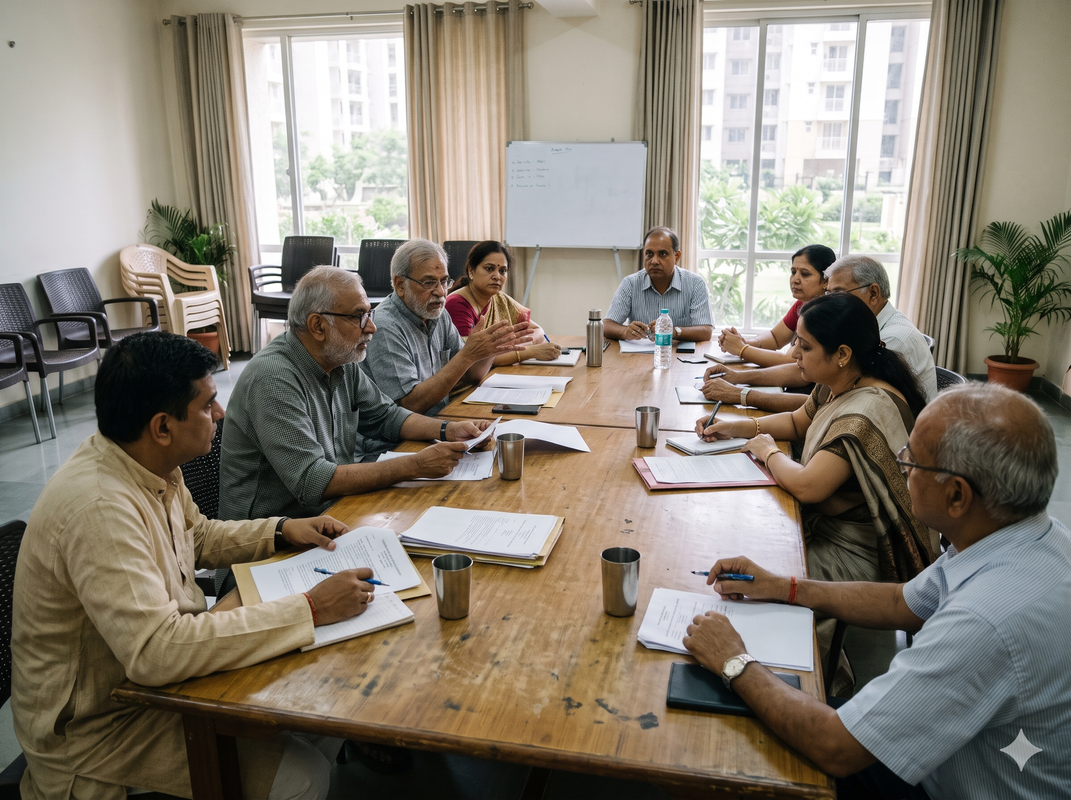
- A managing committee resolution that follows your bye-laws, authorises the project, and names an authorised signatory.
- Clear roof rights. The roof should be common property. If any flat owner holds allocated terrace rights, settle that first.
- A dedicated common-area electricity connection that does not feed individual flats.
- Twelve months of common-area electricity bills, so your installer can size the system against real consumption.
- A structural check of the roof. Older buildings often have water tanks, lift machine rooms, and shading to work around. Our rooftop solar storm safety guide explains why the mounting design matters in Kolkata’s wind conditions.
Step by Step
- Your installer reviews the bills, surveys the roof, and sizes the system.
- The committee or general body approves the project under your bye-laws.
- The society registers as the applicant on the national portal.
- Your power utility reviews feasibility and approves the connection.
- The installer builds the system, and the utility fits the meter and inspects.
- The subsidy follows commissioning.
The technical journey takes roughly 45 to 90 days. Our installation timeline breaks it down stage by stage.
Why Societies Should Start Early
PM Surya Ghar is approved to run until 31 March 2027, so plan around that date unless the government notifies otherwise. Societies decide more slowly than single households, because committee meetings, quotations, and resolutions all take time. Starting now leaves room for all of that and for the installation itself.
Questions to Ask Any Installer
- Can you show the structural and wind-load design for our roof?
- Are the modules DCR, and are you registered on the national portal?
- How will you credit exported units on our common-area connection?
- Who presents to the committee and files the application?
- What after-sales service and warranty do you provide? Our buyer’s checklist lists the other points to check.
Solar for Your Society with Apris Solar
As a solar installation company in Kolkata and Howrah, Apris Solar surveys your building, sizes a system against your common-area bills, and handles the application paperwork. As an EPC (Engineering, Procurement, and Construction) company, we manage design, equipment, and installation as one team, and every installation comes with five years of free after-sales service. Ask us about payment options for your society.
📞 WhatsApp us your last 12 months of common-area bills, or visit apris.in/solar-company-contact-us to book a free site survey.