
Howrah is one of West Bengal’s biggest industrial clusters. Its foundry belt alone has around 300 to 350 units, mostly micro and small enterprises, clustered in Liluah, Salkia, Dasnagar, Balitikuri, Jangalpur and Dhulagarh. Galvanising and wire-drawing units, re-rolling mills and countless workshops sit alongside them. For many of these businesses, electricity is one of the largest costs. In an older Bureau of Energy Efficiency study of the galvanising units, energy made up roughly 14 to 30 percent of production cost. Rooftop solar can cut part of that bill, but only if you know what it can and can’t do.
Why Industrial Solar Works Differently
Homeowners get a government subsidy under PM Surya Ghar. Industrial units don’t, because the scheme covers households and housing societies. The case for industrial solar rests on three other levers:
- Daytime consumption. Units that run day shifts use power while the panels generate it, so they consume most of the solar output directly.
- Tax depreciation. Businesses can claim depreciation on solar systems, which improves the first-year numbers.
- Financing. Banks and other lenders offer term loans for MSME solar projects, so you do not always have to pay upfront.
What Solar Can and Can’t Cut From Your Bill
Industrial tariffs in West Bengal usually have two parts: energy charges per kWh, and fixed or demand charges per kVA. Solar cuts the first part for every unit it generates and you use. It typically does not cut the demand charge. Pull out a recent bill and look at the split between the two before you estimate any savings.

Roof space also sets a ceiling. A system needs roughly 100 sq. ft. per kW, so a 50 kW system takes around 5,000 sq. ft. An induction furnace or a heavy motor load can draw far more than any rooftop can supply, so expect solar to cover part of your load, not all of it.
The Tax Angle
Solar systems currently qualify for depreciation at 40 percent on the written-down-value method. The Income-tax Act, 2025 replaced the 1961 Act from 1 April 2026, so the section numbers changed, and the sources we checked report the 40 percent rate unchanged. One rule matters for timing: an asset used for fewer than 180 days in the year you buy it gets half the normal first-year rate. The date your system goes live can therefore change your year-one benefit. Ask your accountant to confirm the rules for your case before you plan around the number.
Check Your Roof Before You Check Anything Else
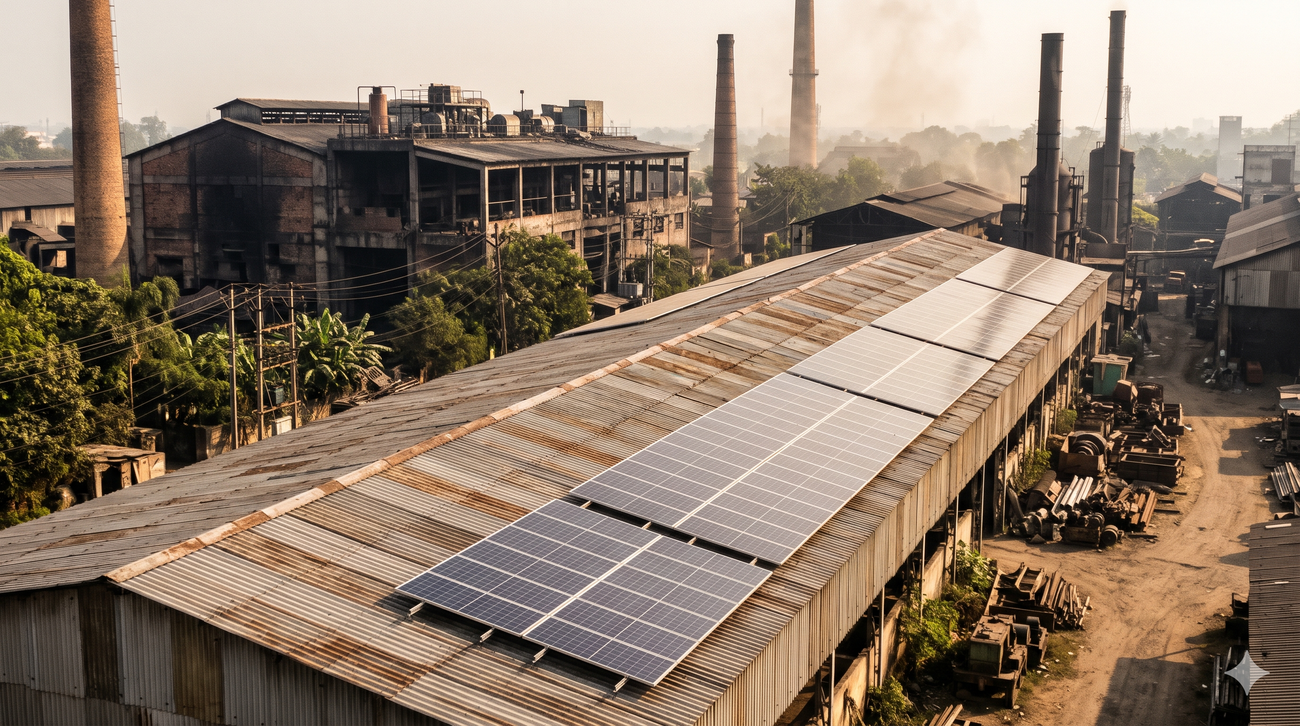
Most industrial roofs are sheds, and the roof decides what is possible.
- GI or tin sheet roofs work well when the installer mounts the system correctly and keeps the roof watertight.
- Asbestos-cement sheets are brittle, and drilling or breaking them creates a health hazard. Installers generally avoid mounting directly on them and may recommend replacing the roof or building a separate structure.
- Age and condition. A weak truss or corroded fasteners need fixing before any panels go up.
- Soot, dust and fumes. Foundries and furnaces deposit soot on nearby roofs, and acid fumes near galvanising or pickling sections speed up corrosion. Ask about cleaning frequency and corrosion-resistant coatings.
- Wind. Open sheds catch storm gusts. Our rooftop solar storm safety guide explains the mounting questions to ask.

Questions About Your Connection
- Which utility serves you? A cluster energy profile reports that Howrah’s foundries mainly buy power from WBSEDCL. Check your own bill, and see our guide to CESC and WBSEDCL if you are unsure.
- High-tension or low-tension? Your connection type affects the approval route and the system design.
- How will the system handle heavy loads? Furnaces and large motors create fluctuating, demanding loads. Ask your installer how they size the inverters and protect the system.
- How will the utility credit exported power? Terms depend on your connection category and the state regulator’s rules, so get this confirmed in writing.
From First Call to Switch-On
- Gather 12 months of electricity bills.
- Your installer surveys the roof and analyses your daytime load.
- The installer sizes the system against that load and models the savings, including depreciation.
- The utility reviews and approves the connection.
- The installer builds the system, and the utility fits the meter and inspects.
Our installation timeline shows how long each stage typically takes.
What to Ask Any Installer
- Can you show me the daytime load analysis, not just a generic estimate?
- What will solar do to my demand charges?
- How do you handle sheet and asbestos roofs?
- What cleaning and maintenance plan do you offer for a sooty, dusty roof?
- Who handles the utility approvals?
Our buyer’s checklist and warranty guide cover the rest. If you are comparing commercial numbers more broadly, see our commercial rooftop solar guide for West Bengal.
Industrial Solar in Howrah with Apris Solar
As a solar installation company in Kolkata and Howrah, Apris Solar surveys your roof, studies your daytime load, and sizes a system around your actual bills. As an EPC (Engineering, Procurement, and Construction) company, we manage design, equipment, and installation as one team, and every installation comes with five years of free after-sales service.
Send us your last 12 months of electricity bills through our contact page and we will book a free site survey.