
Commercial electricity tariffs run noticeably higher than residential rates, and business don’t get the PM Surya Ghar subsidy that homeowners do. Despite that, commercial rooftop solar in West Bengal often pays for itself faster than residential systems — the economics just work differently. Here’s what it actually costs, what businesses get instead of a subsidy, and what real payback looks like.
Commercial Solar Cost by System Size
Larger systems cost less per kW than residential installations, since the equipment and labor scale more efficiently:
| System Size | Cost Per kW | Approximate Total Cost | Typically Suited For |
|---|---|---|---|
| 10 kW | ₹55,000 – ₹70,000 | ₹6 – ₹8 lakh | Small shops, clinics, offices |
| 25 kW | ₹45,000 – ₹60,000 | ₹12 – ₹16 lakh | Larger retail, schools |
| 50 kW | ₹40,000 – ₹55,000 | ₹25 – ₹35 lakh | Mid-sized offices, small factories |
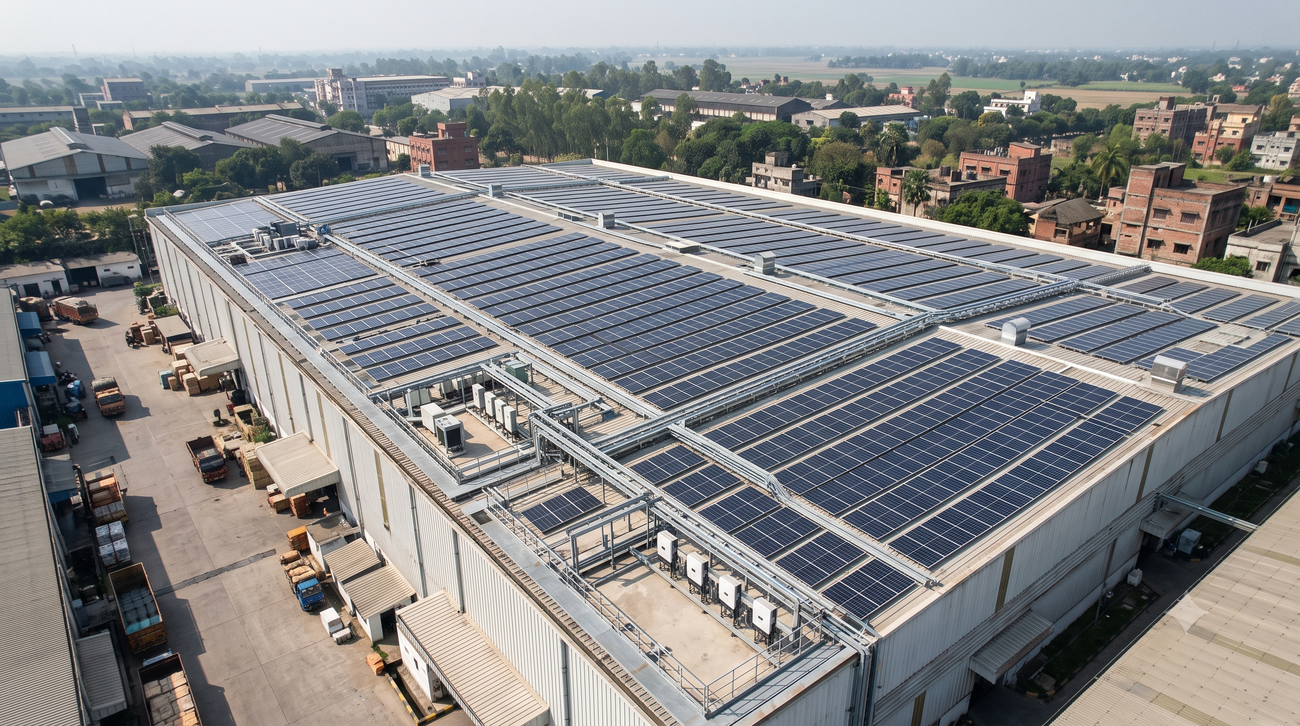
| 100 kW | ₹35,000 – ₹50,000 | ₹40 – ₹55 lakh | Manufacturing units, warehouses |
Exact pricing depends on roof type, panel technology, and site complexity — but the pattern holds: bigger commercial systems get meaningfully better per-kW pricing than small residential ones.
No PM Surya Ghar Subsidy — But a Stronger Lever Instead
PM Surya Ghar Yojana is a residential-only scheme, so commercial buildings don’t qualify. What businesses get instead is arguably more valuable for profitable companies: 40% Accelerated Depreciation under Section 32 of the Income Tax Act. You can write off 40% of your solar system’s value against taxable income in year one alone, with the remaining 60% depreciated over the following years on a written-down-value basis.
For a business in the 25–30% tax bracket, that first-year depreciation alone can offset a meaningful chunk of the system cost — effectively compressing your payback period by 6–12 months compared to simply tracking electricity savings alone.
Net Metering Works the Same Way for Businesses
Commercial rooftop systems connect to the grid and export surplus generation just like residential ones, settled through net metering with your power utility. Daytime-heavy businesses — the ones actually using electricity while the sun is up — get the most value here, since they’re consuming solar power directly rather than exporting most of it and buying it back later.
What Real Payback Looks Like
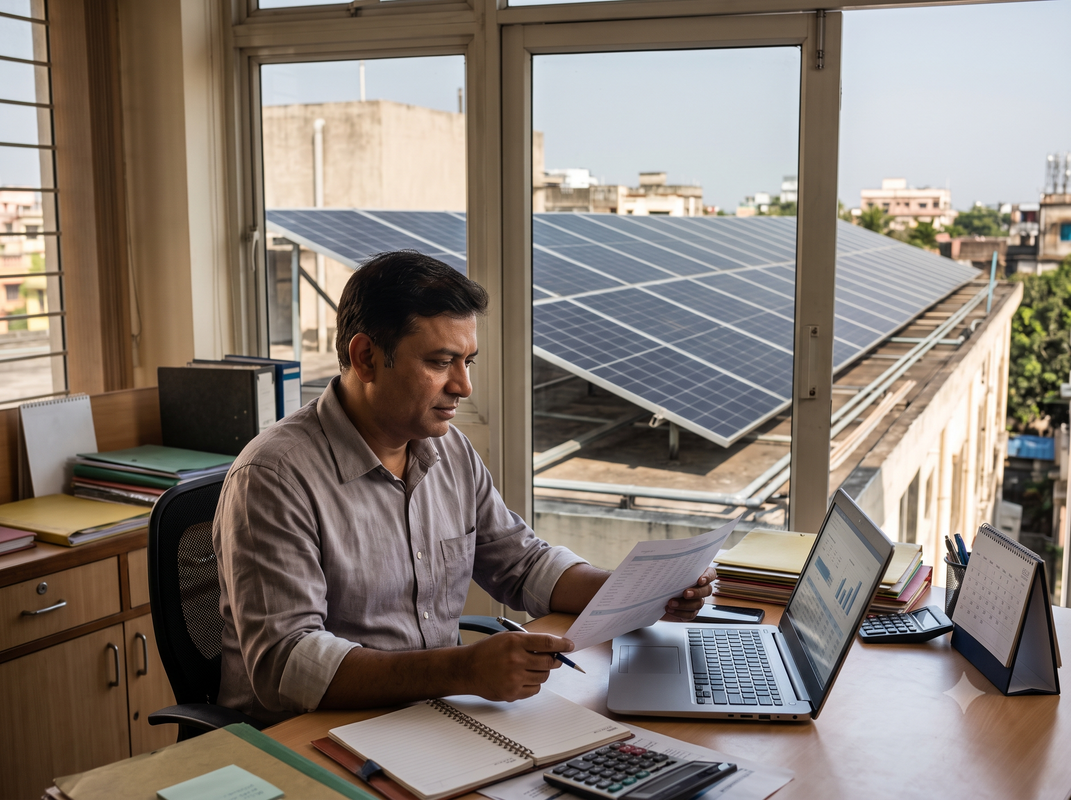
Take a mid-sized business with a ₹50,000 monthly electricity bill and consistent daytime operating hours — a typical profile for a retail showroom, office, or small manufacturing unit in Kolkata or Howrah. A 25 kW system sized to that load, after accounting for first-year accelerated depreciation, commonly pays back in 3–5 years — noticeably faster than most residential systems, purely because commercial tariffs are higher and daytime consumption lines up directly with solar generation hours.
Across the industry, commercial rooftop solar in India typically delivers 18–22% returns for businesses that can fully use the depreciation benefit, with payback consistently landing in that 3–5 year window rather than stretching toward a decade.
Which Businesses Benefit the Most
Solar economics favor businesses with high daytime electricity consumption — the hours when panels are actually generating. That makes these the strongest candidates:
- Retail showrooms and shops with daytime operating hours
- Offices and co-working spaces
- Schools and coaching centers
- Small-to-mid manufacturing units and workshops
- Warehouses with large, usable roof area
- Hotels and hospitality properties with consistent daytime load
A business running mostly in the evening or at night will see a longer payback, since it’s exporting most of its generation rather than using it directly — still worthwhile, but the math is less dramatic than for a daytime-heavy operation.
Financing Options for Commercial Solar
Beyond paying upfront, commercial solar loans and CAPEX financing are widely available, and many businesses structure the investment specifically to maximize the first-year depreciation benefit against that year’s taxable profit — worth discussing with your accountant alongside your installer.
Get a Commercial Site Assessment
Commercial solar sizing depends heavily on your actual load profile, roof structure, and daytime consumption pattern — not something a generic calculator captures well. As an EPC (Engineering, Procurement, and Construction) company, Apris Solar handles design, equipment procurement, and installation in-house for commercial projects across Kolkata and Howrah, the same accountable approach we use for residential systems. If you’re also comparing vendors, the same checklist we use for residential buyers applies just as directly to commercial installers.
For a personalized residential estimate, our solar calculator is a quick starting point — but commercial sizing needs an actual site visit to get right.
📞 WhatsApp us or visit apris.in/solar-company-contact-us for a free commercial site assessment and a quote built around your actual electricity bill and roof.